
TL;DR
IoT in mining is transforming how mining companies manage safety, equipment, and operations. By connecting sensors, machines, and workers through real-time monitoring systems, mines can detect hazards earlier, reduce downtime, and improve operational efficiency.
In this blog, you’ll discover how the application of IoT in mining industry environments helps create safer and more data-driven mining operations.
Key takeaways:
- IoT sensors monitor underground conditions such as gas levels, temperature, and ground stability to improve worker safety.
- Real-time tracking systems help monitor workers, vehicles, and equipment across both surface and underground mines.
- Predictive maintenance powered by IoT can reduce equipment downtime by up to 50%.
- Connected monitoring platforms allow mining companies to respond faster to hazards and operational issues.
- Despite its benefits, challenges for IoT in mining include connectivity limitations, cybersecurity risks, and infrastructure costs.
Mining is one of the most complex and hazardous industries in the world. Heavy machinery, harsh environments, and remote locations pose constant operational and safety challenges.
Through smart monitoring systems, the Internet of Things (IoT) helps companies address these issues.
It allows companies to collect and analyze real-time data from across mine sites. Operators can monitor conditions, track assets, and prevent equipment failures with connected sensors, advanced analytics, and automated alerts.
As a result, IoT for mining industry environments is becoming essential for improving safety, reducing costs, and increasing productivity.
How Does IoT Improve Mining Safety?
IoT improves mining safety by continuously monitoring environmental conditions and worker activity using connected sensors and wearable devices. These systems detect hazards in real time and send alerts to help prevent accidents.
Traditional safety inspections rely heavily on manual checks, which may miss sudden changes in temperature, ground conditions, or underground environmental hazards. IoT monitoring systems solve this problem by providing constant visibility.
Examples of IoT safety technologies include:
- Gas sensors that detect methane, carbon monoxide, and oxygen levels
- Environmental sensors that monitor temperature, humidity, and ventilation conditions
- Wearable devices that track worker location and activity
- Connected helmets that can detect fatigue or falls
When abnormal conditions are detected, supervisors or control centers are automatically notified so that corrective actions can be taken quickly. Open integration platforms such as Open Automation Software (OAS) enable real-time communication between field devices, SCADA systems, databases, and cloud platforms. This ensures safety alerts and operational data are instantly accessible across the organization,
Beyond real-time monitoring, IoT systems can also help predict potential hazards before they occur. For example, researchers developed an IoT-based system to measure and predict ground vibration levels during limestone blasting operations. The system, combined with machine learning models such as Random Forest, achieved high predictive accuracy (R² = 0.92) and vibration measurement errors below 1%. By forecasting hazardous vibration levels in advance, mining operators can implement preventive safety measures and reduce risks to workers and nearby communities.
What Sensors Are Used in Mining Operations?
An IoT sensor network collects operational and environmental data across mining sites. These sensors provide continuous feedback on safety, productivity, and the performance of equipment.
Common sensors used in modern IoT in mining industry deployments include:
| Sensor Type | Purpose |
| Gas sensors | Monitor methane, carbon monoxide, and oxygen levels |
| Vibration sensors | Detect equipment wear and structural instability |
| Temperature sensors | Identify overheating machinery |
| Humidity sensors | Monitor underground environmental conditions |
| Proximity sensors | Prevent vehicle-worker collisions |
| Location sensors | Track equipment and personnel movement |
Thousands of sensors may operate simultaneously in large mining sites. Their data is transmitted through wireless networks to centralized monitoring systems where engineers and operators can evaluate real-time conditions.
This sensor-based monitoring represents one of the most important applications of IoT in mining industry operations.
How Does Real-Time Tracking Work in Mining?
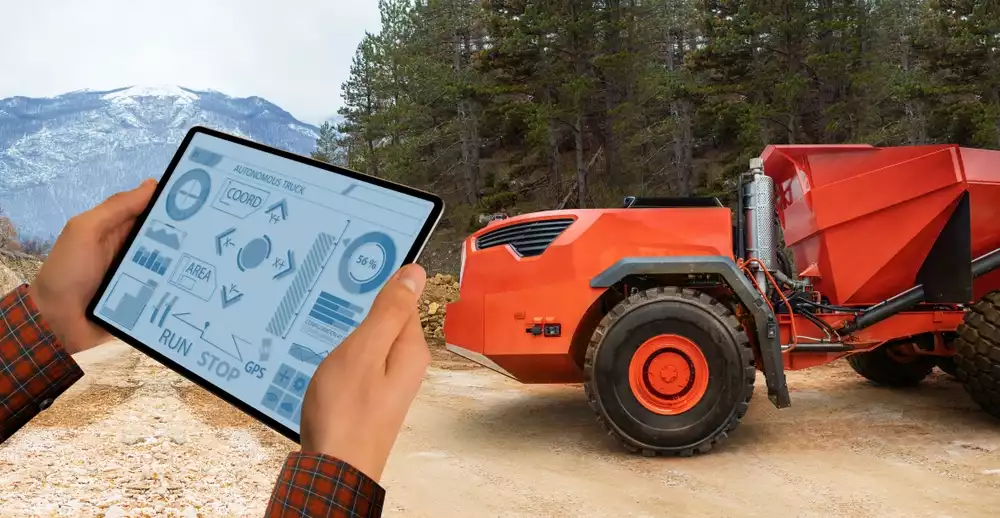
Real-time tracking systems use connected tags, wireless signals, and positioning technologies to monitor workers’ locations, vehicles, and materials across mining sites.
These systems improve operational visibility and allow managers to coordinate activities more efficiently.
Depending on the mining environment, tracking technology varies:
Surface Mining Tracking
Surface mines typically rely on GPS-based systems that track vehicle fleets and heavy equipment. These systems enable operators to monitor truck routes, optimize dispatch schedules, and reduce idle time.
Underground Mining Tracking
Underground mines require alternative positioning systems since GPS signals cannot penetrate rock layers. Instead, companies use technologies such as:
- RFID tags
- Bluetooth beacons
- Ultra-Wideband (UWB) positioning systems
- Wireless mesh networks
These technologies create digital maps of workers and equipment locations inside the mine.
Real-time visibility improves emergency response. Operators can guide workers to safe exits if an evacuation is required. The ability to track data is one of the most valuable benefits of IoT in mining industry safety programs.
What are The Challenges for IoT in Mining?
Despite its advantages, there are several challenges for IoT in mining that can affect adoption timelines and system performance.
Companies implementing them must address the following technical and operational obstacles:
Connectivity Limitations
Mining sites are often located in remote regions where traditional wireless infrastructure is limited. Communication networks can also be difficult to deploy underground due to tunnels.
Cybersecurity Risks
Connected sensors and industrial systems increase cyberthreat entry points. Mining companies must implement strong cybersecurity policies and network protections.
High Implementation Costs
Data analytics, communication infrastructure, and sensors require large investments up front. Long-term operational savings typically offset these costs.
Data Integration Complexity
Modern IoT platforms must integrate legacy systems in mining. It may also be necessary to use specialized analytics tools and expertise to manage large volumes of sensor data.
Emerging technologies such as private 5G networks, edge computing, and satellite communication address many of these limitations.
The Future of IoT in Mining Operations
Digital transformation is rapidly reshaping mining operations, and IoT in mining plays a central role in this shift.
Platforms such as OAS integrate industrial devices, control systems, and enterprise data platforms into a single architecture for mining companies. With real-time data connectivity and scalable industrial integration, OAS allows organizations to deploy IoT solutions faster and turn operational data into actionable insights.
Explore how Open Automation Software supports industrial IoT deployments and data integration across mining environments. Take a 30-day full-featured trial with all components included!
FAQs About IoT in Mining
What is IoT in the mining industry?
IoT in the mining industry refers to the use of connected sensors, devices, and data platforms that collect real-time information from mining operations. These systems help companies monitor safety conditions, track assets, and optimize equipment performance.
What are the benefits of IoT in the mining industry?
The main benefits include improved worker safety, predictive maintenance, real-time operational visibility, and more efficient resource management. Mining companies can also reduce downtime and improve productivity through data-driven decision-making.
Industrial data platforms like OAS, connects PLCs, sensors, and industrial control systems to analytics platforms, making it easier to monitor equipment performance and trigger predictive maintenance workflows.
What is the biggest challenge for IoT in mining?
The biggest challenge is maintaining reliable communication networks in remote and underground environments. Without stable connectivity, sensor data cannot be transmitted effectively, limiting the impact of IoT monitoring systems.
Can IoT reduce equipment downtime in mines?
Yes. One of the most impactful applications of IoT in mining industry operations is predictive maintenance, which helps identify equipment issues before they lead to costly breakdowns.
Mining equipment such as haul trucks, crushers, and drilling machines operates under extreme stress. Unexpected failures can halt production and cause significant financial losses.